The Eccles Institute & Hay Festival Global Writer’s Award
An award granting £20,000 and year-long residency at the Library to two writers for a yet-to-be-published book relating to the Americas. Six incredible authors have been shortlisted: Alexa Hagerty, Daniella Sánchez Russo, Hanna Limulja, Nick Makoha, Jeremías Gamboa and Natalia Sobrevilla Perea. The two winners will be announced on Tuesday 17 November.
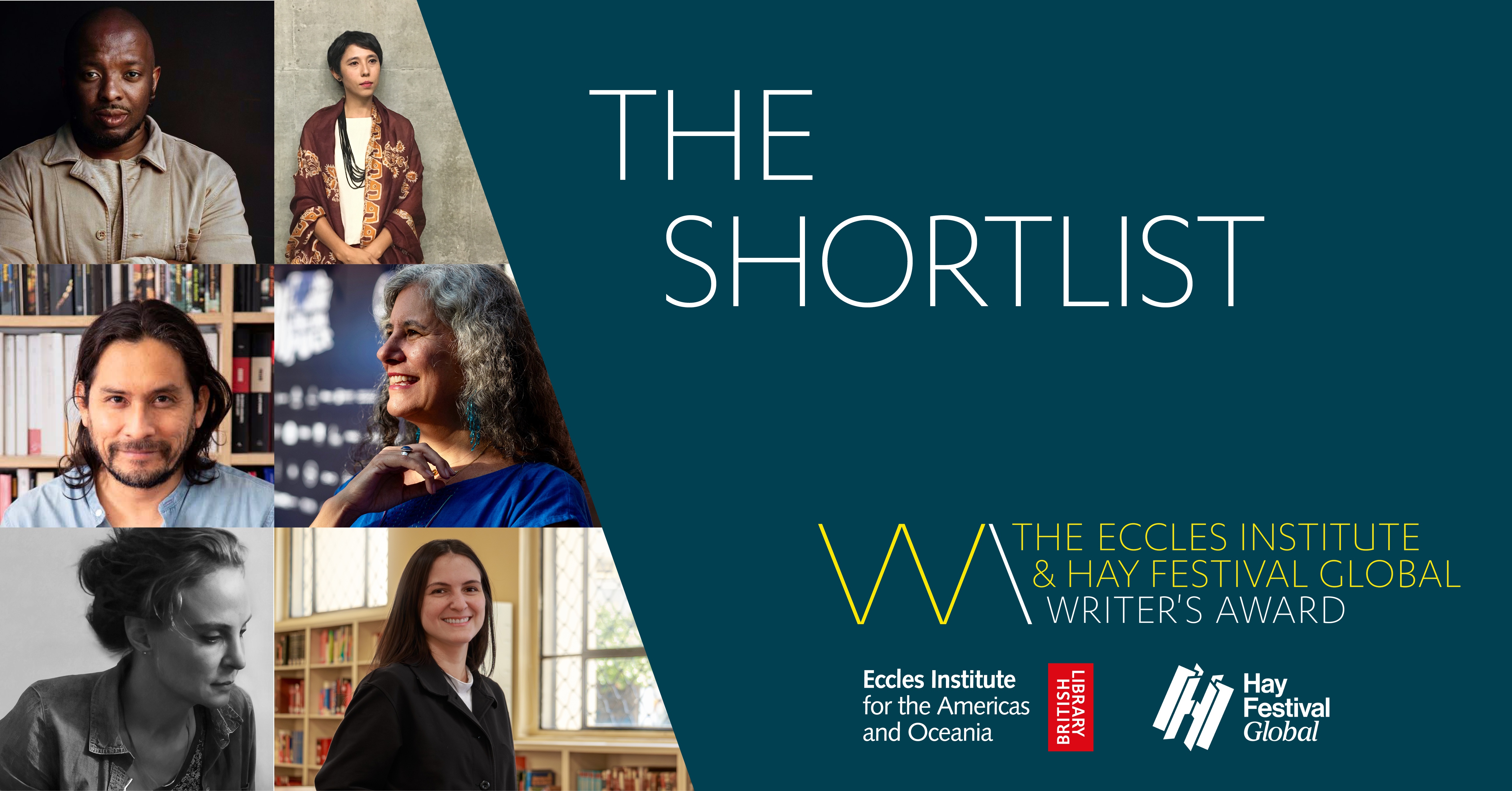
Shortlist for the 2027 award announced
Six incredible writers make up the 2027 shortlist:
American writer and anthropologist Alexa Hagerty
Colombian writer and researcher Daniella Sánchez Russo
Brazilian writer, anthropologist and lecturer Hanna Limulja
Ugandan-born British poet, playwright and academic Nick Makoha
Peruvian writer, journalist and teacher Jeremías Gamboa
Peruvian-British researcher Natalia Sobrevilla Perea
The two winners will be announced on Tuesday 17 November and will take up the Writer’s Award for one year from 1 January 2027. The award is judged by a panel comprising Cristina Fuentes La Roche (Hay Festival International Director), Polly Russell (Head of the Eccles Institute for the Americas and Oceania at the British Library), Colin Grant (Director of WritersMosaic), Mercedes Aguirre (Deputy Head of the Eccles Institute) and the panel’s chair, Catherine Eccles (Eccles Fisher Associates Director).
‘We are incredibly excited by the breadth and depth of the 2027 Eccles-Hay Writer's Award shortlisted projects. Including a new history of the Spanish and Latin American encounter, a re-evaluation of the artist Basquiat, reflections on the legacies of internalised racism and armed conflict, a deep dive into the environmental costs of our digital world, and an account of Indigenous cosmologies, the shortlisted projects explore complex histories and difficult legacies. They offer new ways to understand our shared challenges and showcase some of the most exciting voices writing about, and from, the Americas today.’
Polly Russell, Head of the Eccles Institute for the Americas and Oceania at the British Library
‘We are delighted to announce the shortlist for this year’s Eccles Institute & Hay Festival Writer’s Award. Spanning non-fiction, poetry, memoir, history and a novel in verse, these projects offer a range of fresh perspectives on the Americas – common histories, the challenges we face, and what we hope the future holds. It’s a privilege to follow these projects as they develop and support these writers as their work takes shape.’
Cristina Fuentes La Roche, International Director at Hay Festival
About the shortlisted writers
More about the writers, their projects and what stood out to the judges.
Alexa Hagerty
Alexa Hagerty is a writer and anthropologist whose work follows the forensic search for people disappeared by Latin American dictatorships. Her first book, Still Life with Bones: Genocide, Forensics, and What Remains (Crown, 2023), was a New York Times Editors’ Choice and won the Juan E. Méndez Book Award for Human Rights in Latin America. Her second, The Future of Grief, is forthcoming with Norton Shorts. She holds a PhD in anthropology from Stanford and is a visiting scholar at ISAE-SUPAÉRO and affiliated researcher at Cambridge’s Minderoo Centre for Technology and Democracy. She previously co-led a working group on disability and AI with LSE and Ada Lovelace Institute’s JUST AI project.
The judges said: ‘A literary non-fiction about the Atacama in Chile, the driest nonpolar desert on Earth: Salt, Cloud, Ghost: A Journey through Desert, Deep Time, and Digital Age, will unfold over nine chapters, each anchored in a single site in the desert, and will examine mining and the minerals taken from the ground, and the digital world they are building after five centuries of extraction and histories of violence.’
Daniella Sánchez Russo
Daniella Sánchez Russo is a Colombian writer and researcher working across literary scholarship, creative writing and the cultural sector. She is the author of Vigilia (Tusquets, 2022), a novel about how Colombia’s armed conflict, economic development and domestic labour shape intimate life in the Caribbean, which will be published in English by Charco Press in 2027. She holds a PhD in Romance Languages from the University of Pennsylvania and an MFA in Creative Writing from New York University. She previously served as Director General of the Instituto Caro y Cuervo and is currently working on Rezo, a novel in verse about how political violence enters a couple’s private life.
The judges said: ‘From the author of Vigilia, to be published in English next year as Wakeful Hours, comes Rezo, a novel in verse about the transformation of an intimate relationship when Colombia’s armed conflict enters the lives of a couple indirectly. The project continues Daniella Sanchez’ longstanding interest in the ways collective histories become embedded in private life.’
Hanna Limulja
Hanna Limulja is a writer, anthropologist and lecturer at the Federal University of Roraima (UFRR) in northern Brazil, where she teaches Indigenous students from the Yanomami, Ye’kwana, Wai Wai, Macuxi, Wapichana and Taurepang peoples, among others. Her doctoral research on Yanomami dreams became The Desire of Others: An Ethnography of Yanomami Dreams (UBU, 2022), a bestseller that has crossed over from academia into schools, psychoanalysis, the arts and literature, and has been translated into Spanish and Catalan. She is also the author of the children’s book Mari hi: The Tree of Dreams (UBU, 2023), which reflects on death from an Indigenous perspective. Active alongside Indigenous peoples in Brazil since 2008, she has worked with CCPY, the Socio-Environmental Institute (ISA), Wataniba and Survival International.
The judges said: ‘For the Amazonian Yanomami people, dreams play a crucial role in how they inhabit, understand and imagine the world. Delving into the archive, Hanna’s project will explore how Indigenous dreams were portrayed in the accounts of missionaries and travellers, and the ways in which they served as a means of resistance and challenge. We were excited by the project’s potential to illuminate Indigenous-colonial encounters through the lens of dreams and, in doing so, offer a different way of knowing and being.’
Nick Makoha
Nick Makoha is a Ugandan-born British poet, playwright and academic based in London. His second poetry collection, The New Carthaginians (Penguin, 2025), weaves Basquiat’s paintings, the 1976 Entebbe hijacking and diasporic myth into a single polyphonic sequence. It was shortlisted for the T.S. Eliot Prize and the Jhalak Prize, longlisted for the Griffin Poetry Prize, and named a Guardian Book of the Year, with a US edition forthcoming from Milkweed in 2027. His debut collection, Kingdom of Gravity (Peepal Tree Press, 2017), was shortlisted for the Felix Dennis Prize for Best First Collection, and his play The Dark (Fuel Theatre, 2019) toured nationally. A 2026 winner of the Cholmondeley Award, he founded the Obsidian Foundation, a UK poetry development programme for Black poets, and holds a doctorate in Creative Writing from King’s College London.
The judges said: ‘Nick Makoha’s proposal, The Hitek Woolf, centres on the art of Jean-Michel Basquiat. Makoha’s response to the arts’ resonances as an African diasporic poet is elegant and passionate. We were struck by the clarity, tone and confidence of Makoha’s writing which heralds an empathic enquiry into the work of Basquiat, a kind of cross-disciplinary call and response.’
Jeremías Gamboa
Jeremías Gamboa is a Peruvian writer, journalist and teacher, born in Lima in 1975 to campesino parents who migrated from Ayacucho. He is the author of the short story collection Punto de fuga (Alfaguara, 2007) and the novels Contarlo todo (2007), winner of Spain’s Tigre Juan prize in 2014 and translated into French, Portuguese and Italian, Animales luminosos (2021) and El principio del mundo (Alfaguara, 2025). His recent fiction turns to family memory, the trauma of political violence and internalised racism. A former editor at Somos, Debate and Etiqueta Negra, he edited the book accompanying the Truth and Reconciliation Commission’s photographic exhibition Yuyanapaq. He holds a master’s degree in Hispano-American Literature from the University of Colorado Boulder, has taught journalism and creative writing at the Pontificia Universidad Católica and the Universidad de Ciencias Aplicadas, and is currently completing a family memoir about his father’s love of reading.
The judges said: ‘Cómo aparecer completamente (How to Appear Completely) is a narrative essay project by Peruvian writer Jeremías Gamboa. Combining personal memoir and historical research, the book explores internalised racism and the denial of Indigenous roots in Peru. Through his family history and research at the British Library, Gamboa will examine how colonial representations have shaped identity across generations, embarking on a deeply personal journey to reclaim his origins and embrace an identity long denied. A timely and necessary book by a writer whose work explores the complexities of race, class and identity in contemporary Peru.’
Natalia Sobrevilla Perea
Natalia Sobrevilla Perea is a Peruvian historian, born in Lima in 1971, who specialises in the independence era and the nineteenth-century political history of the Andes. She holds a doctorate from the University of London on the political culture of Peruvian caudillos in the Guano era and taught at the University of Kent from 2007 to 2024, where she held the Chair of Latin American History. She coordinated a network of South American scholars studying the shared history of the independence movements, whose collaborative book appeared in Spanish in 2021 and is due in English in October 2026. She also led projects with the British Library’s Endangered Archives Programme to digitise regional Peruvian newspapers and archives. She is currently a researcher at the Riva Agüero Institute of the Pontifical Catholic University of Peru and is completing a project on the mid-nineteenth-century civil wars in the new South American republics.
The judges said: ‘Were We Never Colonies?, her submission for the award, offers a thought-provoking exploration of the historical relationship between Spain and colonial Latin America, challenging current narratives that relegate the region’s pre-Hispanic past and downplay centuries of inequality.
About the Award
The Eccles Institute & Hay Festival Global Writer’s Award is a residency prize that grants up to £20,000 annually to two writers from the UK and Latin America for a yet-to-be-published book relating to the Americas.
Established in 2012, the annual award has seen over 30 writers develop incredible work exploring a rich variety of themes relating to the Americas working in fiction, non-fiction, memoir and more.
They’ll be in good company. Previous winners include...

2026
Jacqueline Crooks and Vanessa Londoño are the current Writer’s Award holders. Crooks won for Out of Many, a hybrid work of auto-fiction and memoir, and a literary excavation of Caribbean fatherhood and identity. Londoño won for Through Arrival Waters, a compelling proposal for her book , which explores the vast collection of imagined maps that once sought to locate the mythical South American city of Manoa — also known as El Dorado —.
2025
Peter Brathwaite and Joseph Zárate won the Writer’s Award in 2025. Bratwaite won for a non-fiction exploration of identity, history and memory, through the lens of his Barbadian and British heritage, Not All of Me Will Die. Zárate won for Todo nace en el agua y muere en ella, which takes inspiration from Zarate’s 90-day journey on foot and boat following the same route of Spanish conquistador, Francisco de Orellana, five centuries ago when he set out to ‘discover’ the Amazon River.

2024
Hannah Lowe and Alia Trabucco Zerán won the Writer’s Award in 2024. Lowe won for a lyrical, hybrid memoir, Moy: In Search of Nelsa Lowe, where she uses the intimate story of her Chinese Jamaican aunt as a device for exploring the history of the Chinese in Jamaica. Trabucco Zerán won for Impudence ('Descaro'), where she weaves fiction with memoir and essay to explore portrayals of Latin American women and our relationship with the female face, identity and loss.
2023
Ayanna Lloyd Banwo won for Dark Eye Place which tells the story of a family house, passed down to the daughter of each generation. Jarred McGinnis won for The Mountain Weight, which mines his family’s history, from the American Civil War to the present day, to examine themes of masculinity, family and migration.
2022
Philip Clark won for Sound and the City, a history of the sound of New York City and an investigation into what makes New York sound like New York. Javier Montes won for Trópico de Londres (Tropic of London), telling the story of Latin American artists, writers and intellectual exiles in London during the second half of the 20th century.

2021
Pola Oloixarac won for Atlas Literario del Amazonas (Literary Atlas of the Amazon) – a work of creative non-fiction revealing the secret history of the Amazon. Imaobong Umoren won for Empire Without End: A New History of Britain and the Caribbean – an expansive new history of the 400 year relationship between Britain and the Caribbean.
2020
Novelist and writer Chloe Aridjis for her novel Reports from the Land of the Bats and writer and editor Daniel Saldaña París for his novel Principio de mediocridad.
2019
Writer Rachel Hewitt and novelist Sara Taylor. Hewitt is a Lecturer in Creative Writing, and author, Sara Taylor is a novelist as well as co-director and editor of creative-critical publisher Seam Editions.
Portrait of the award winners by Clara Molden.

2018
Novelist and short story writer Stuart Evers, and the author, librettist and screenwriter Tessa McWatt.
2017
Author Hannah Kohler and writer and musician Bob Stanley.
2016
Author and editor William Atkins, and author Alison MacLeod. Atkins' The Immeasurable World: Journeys in Desert Places was published by Faber in 2018.
2015
Professor Sarah Churchwell and novelist Benjamin Markovits. Markovits' novel A Weekend in New York was published by Faber in 2018.
2014
Critic and writer Olivia Laing and journalist Erica Wagner. Laing's book The Lonely City: Adventures in the Art of Being Alone was published by Picador in 2016 and was shortlisted for the Gordon Burn Prize. Wagner's Chief Engineer: The Man Who Built the Brooklyn Bridge was published in 2017 by Bloomsbury.
2013
Historian Andrea Wulf and poet and novelist John Burnside. Wulf’s book The Invention of Nature: The Adventures of Alexander von Humboldt, the lost Hero of Science was published by John Murray in October 2015 and won the 2015 Costa Biography Award and 2016 Royal Society Science Book Prize. Burnside's novel Ashland and Vine was published by Jonathan Cape in 2017.
2012
Writer Sheila Rowbotham and novelist Naomi Wood. During her 2012 residency, Wood researched her novel, Mrs Hemingway, which was published by Picador in 2014. Rowbotham's group biography Rebel Crossings: New Women, Free Lovers, and Radicals in Britain and the United States was published by Verso in 2016.
Portraits of the 2012–2018 award winners by Eccles Photography Fellow Ander McIntyre.
About the Eccles Institute
The Eccles Institute for American Studies was founded to increase awareness and use of the British Library's extensive collections of books, manuscripts, journals, newspapers and sound recordings related to the Latin America, United States, Canada and the Caribbean.
Housed within the British Library, the Institute's curatorial, research and engagement experts build and preserve the Library's Americas collections and run a diverse programme of public events and support for creative, academic and community researches.
