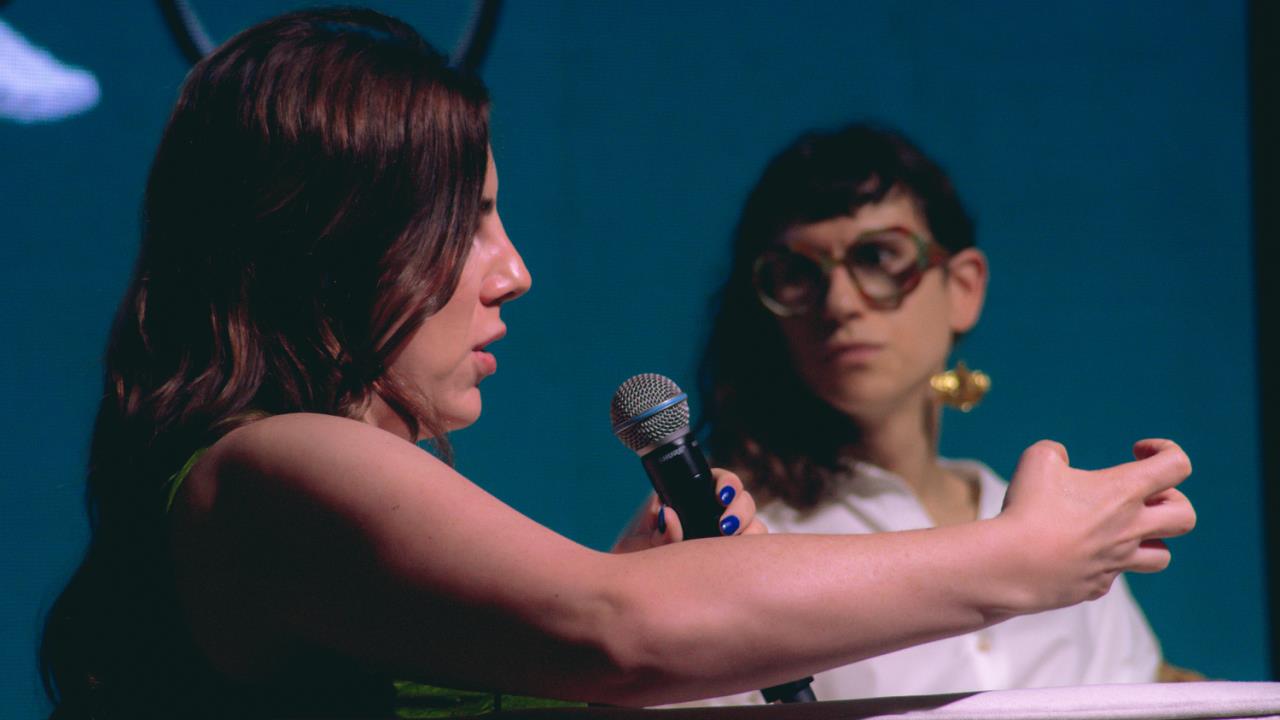
Participating in Hay Festival Cartagena de Indias was an exciting opportunity for me to discuss my first book The Transgender Issue (or 'Trans' in Spanish) in an international forum outside of Europe. I was lucky to be paired with the Spanish author Fer Rivas who was there to discuss her first novel, Jo era un noi (or 'Yo era un chico' in Spanish), a work of autofiction about masculinity, father-child relationships and class. Our discussion was chaired by Nicolas Morales, a political analyst and editor based in Colombia.
A panel event featuring three writers from three different countries allowed us a breadth of experience and reference to talk about mine and Fer’s work in conjunction with one another. Nicolas graciously opened the discussion by talking about its political significance in Colombia where, just last year, the country was shaken by the violent murder of 32-year-old Sara Millerey González, a trans woman, in Bello, near the city of Medellin. Sadly, as Nicolas explained, such violence demands our collective attention and solidarity.
Fer Rivas is a fiction writer, and I am a nonfiction writer, so the pairing of our books provided as much room for contrast as it does for comparison. I explained during the event that I think fiction’s advantage is that it can sit in ambivalence and contradictions, much like life, whereas political nonfiction requires decisive analysis. Yet, despite the different approaches of our books, Fer Rivas and I share much in our beliefs about gender’s relationship to class politics and that gender is a problem for everyone in a patriarchal society – it’s as much a stifling force in the lives of straight cisgender people as it is in the stories of trans people.
It was refreshing and energising for me to see beyond my own frame of reference with the current culture war against trans people in the UK to see that, in Latin America, transfeminism is a vital part of broader feminist organising and activism against far right and fascist politics. In a way, this gave me hope and inspiration about my own future work as a political writer, encouraging me to research and learn more about LGBTQ+ politics in Colombia and other countries and think in an internationalist ways about resisting oppression.