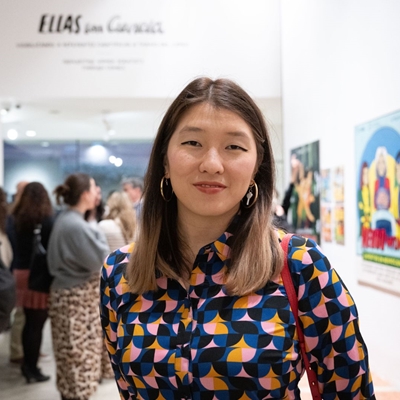
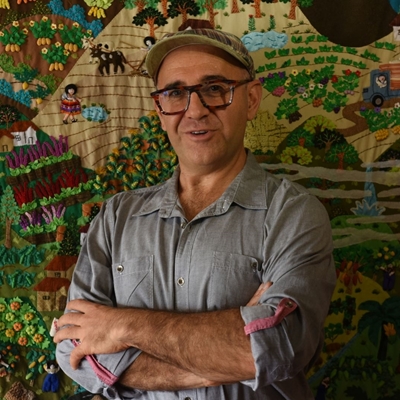
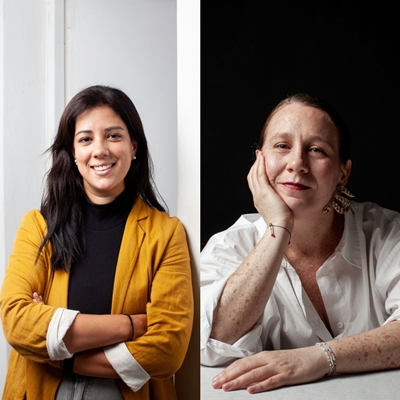
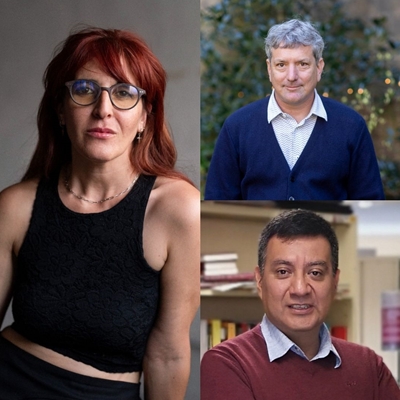
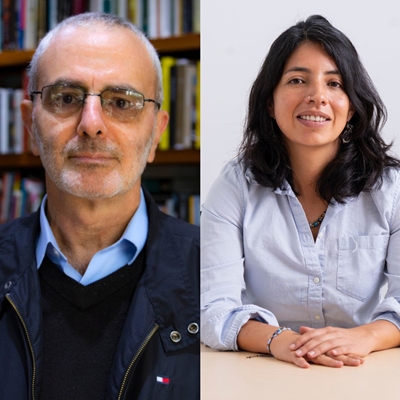
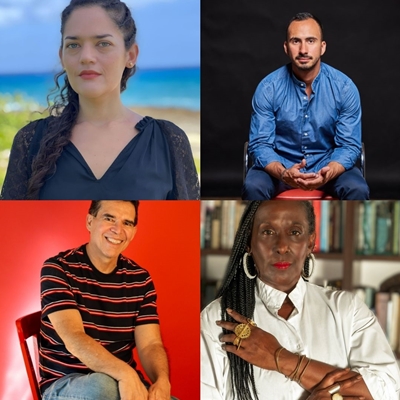
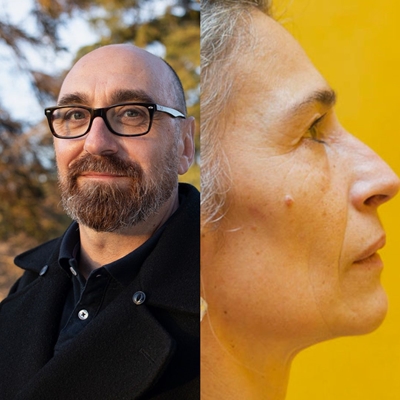
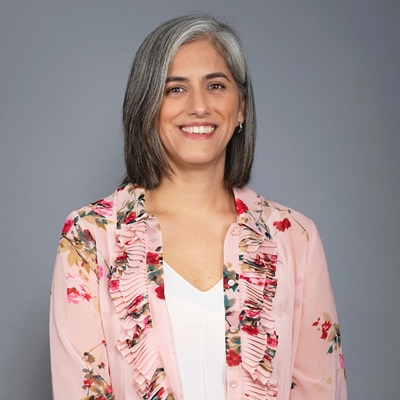
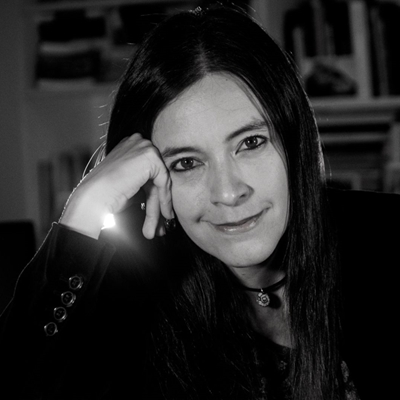
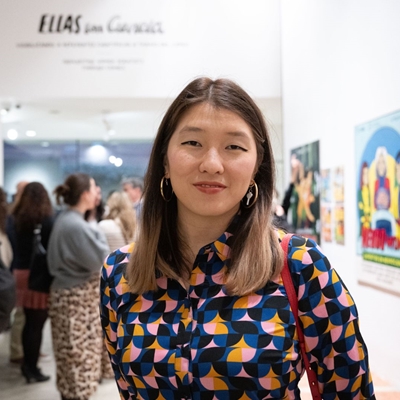
From neither here nor there? Or Andalusian and Chinese at the same time? As the daughter of immigrants born in Spain, Quan Zhouhas often found herself on both sides of the fence, caught between questioning her own identity and being the target of racist discrimination. These life experiences have been covered by her with intelligence and humour, in autobiographical works such as the comics Gazpacho agridulce and Andaluchinas por el mundo, as well as the graphic essay Gente de aquí, gente de allí. She is also the creator of the documentary podcast Mi familia española, which uncovers an invisible chapter in the recent history of Spain: the experiences of migrant mothers, their children, and the Spanish nannies who looked after them in the 1980s and 1990s, when racial diversity was virtually non-existent.
Free admission until full capacity
Sponsored by PUCP, with the support of Acción Cultural Española, AC/E
Mircea Cărtărescu in conversation with Giovanna Pollarolo
The most Macondian Romanian
–
Lima PUCP
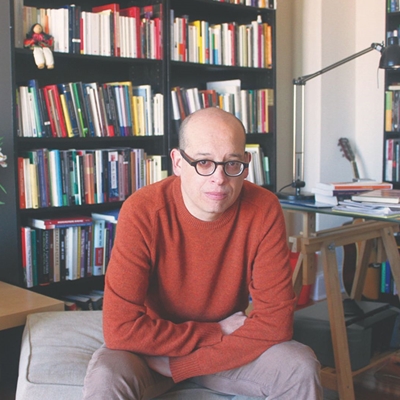
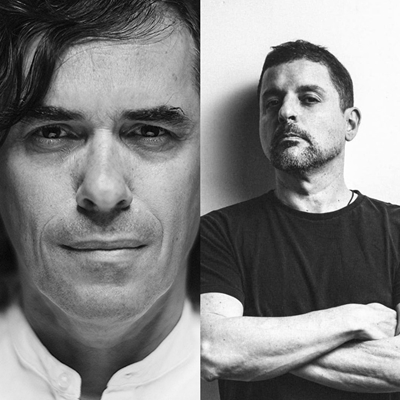
Mircea Cărtărescu (Romania) is one of the most prominent authors in contemporary European literature. A writer with a mystical bent, he has constructed a dreamlike, almost Macondian literary universe in which the real and the imaginary are interwoven with lyrical force. The author himself has remarked that some people view Romania as a Latin American country lost in Europe, and that he agrees with this view. The author of more than twenty books of poetry, fiction and essays, his most recent works translated into Spanish are the monumental Blinding trilogy—considered to be the summit of his literary output, together with Solenoid, Theodoros and Los conocedores. In conversation with Giovanna Pollarolo.
Consecutive interpretation from Romanian to Spanish available
De la mano de Sheena Mayumi Arpasi Catacora, terapeuta especialista en movimiento consciente, las y los residentes del Asilo Víctor Lira, aprenderán a habitar el cuerpo a través de movimientos de yoga suaves, conscientes, sentados en sus sillas, y a través de meditación motivacional. Los ejercicios estarán acompañados de sonidos de cuencos tibetanos y guitarras, por parte de Doris Zuzunaga.
Alessandra Pinasco en conversación con Ingrid Cafferata Vega
Tan simple, tan puro
–
Centro de Convenciones Jorge Basadre Grohmann
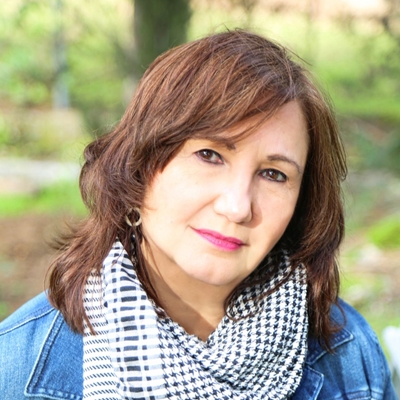
Tan simple, tan puro es el salto de Alessandra Pinasco a la narrativa, tras años dedicándose a la poesía. Lo hace con una colección de cuentos sobre mujeres que exploran el deseo, la memoria y la autonomía en un mundo marcado por la hipocresía y la violencia. Mujeres que, en definitiva, desafían lo que la sociedad conservadora ha establecido para ellas: las presiones de grupo y la idea de ser vistas como individuos carentes de deseo erótico.
Está que se quema, de Xabier Díaz de Cerio(España) no es un libro sobre la crisis climática, es un libro sobre cómo se cuenta la emergencia climática; del enfoque narrativo depende la respuesta ante este desafío. Mediante 50 puntos clave, el periodista científico recorre cuestiones como los orígenes científicos del calentamiento global en el siglo XIX hasta los desafíos críticos de América Latina para informar acerca del tema. Además de diagnosticar la situación, ofrece soluciones, como la vía para traducir la abstracción planetaria en historias locales, humanas y movilizadoras.
Closed event for the educational community of COAR
Rosa Chávez Yacila in conversation with Fedra Rodríguez Pissano
Las nerviosas
–
Centro de Convenciones Jorge Basadre Grohmann
When Rosa Chávez Yacila (Peru) wrote Las nerviosas, she was writing about her mother and the women in her family; about bodies made for domestic labour; about immaterial heritage; about ancestors who never found the space to heal their wounds. Women who are melancholy, “nervous”, from a grief that seems to go from generation to generation. Because there were always other priorities. Because the link between poverty and mental health is not a matter in question, but something obvious to see. The novel’s author will talk to Fedra Rodriguez Pissano.
Alberto Vergara in conversation with Fernando Rondinel Diaz
Peru explained
–
Centro de Convenciones Jorge Basadre Grohmann
Peru global, co-edited by Alberto Vergara and Adrián Lerner, is the first volume in a series that aims to explain Peru in relation to the wider world. Around twenty researchers analyse key moments in the country’s history, situating each of these events within the broader global narrative. This is because no country exists in isolation and because, at times, to grasp the specific, one needs to understand the bigger picture, with its global context and underlying causes. The political scientist and author Alberto Vergara will speak to Fernando Rondinel Diazabout how a global historical perspective can provide a better understanding of Túpac Amaru, independence, the war with Chile, Asian migration, Flora Tristán, Víctor Raúl Haya de la Torre and José Carlos Mariátegui.
Fietta Jarque in conversation with Carlos Capellino Fuentes
Blanca Varela, la vértebra perdida
–
Centro de Convenciones Jorge Basadre Grohmann
On the centenary of Blanca Varela’s birth, tributes to the Peruvian poet have flourished, and one outstanding example is Fietta Jarque’s biography La vértebra perdida. Through interviews and published material, the journalist and writer delves into pivotal moments such as Varela’s trip to Europe and her integration into the cultural world, as well as darker chapters, such as the death of her son Lorenzo and her dismissal as director of the Fondo de Cultura Económica. A biographical account that reconstructs, through a meticulous examination of her life, her personal and literary journey from Lima to international acclaim.
Santiago Roncagliolo in conversation with Gabriela Caballero Delgado
The unexpected rise of Leo XIV
–
Centro de Convenciones Jorge Basadre Grohmann
El pastor y los lobos by Santiago Roncagliolo(Peru) is the true story of Pope Leo XIV and the darkness. The story: a narrative investigation into Robert Prevost’s rise to the papacy. The darkness: the internal struggles, contradictions and challenges facing the Catholic Church. Two factions, one reformist and the other fundamentalist; two ways of understanding the Church, and one had to choose the successor to Francis I. It was here that the discreet figure of Prevost, far removed from the media spotlight, emerged. Roncagliolo traces the clergyman’s path, from his ecclesiastical and social work in Chiclayo to his pivotal role in investigating the Curia’s most murky cases. He also weaves a personal narrative in which he confronts values such as hypocrisy and faith, as well as corruption and justice. He will speak with Gabriela Caballero Delgado.
Un líder no solo se diferencia por su buen hacer y sus casos exitosos. También es importante saber reinventarse y dónde invertir en el futuro. Javier Calvo Pérez es un empresario fundador de Liderman, la empresa de seguridad más importante del Perú, que también se expandió a países como Ecuador y Chile. En su libro, Aquí nadie se hunde, conversa sobre liderazgo y cultura corporativa, basándose en su experiencia como referente empresarial. En sus páginas hace un paralelismo entre la navegación y liderar una empresa. Las y los estudiantes asistentes aprenderán cómo saber adaptarse, trazar objetivos y gestionar posibles crisis de la mano de uno de los empresarios más exitosos del país.
¿Tienes ganas de escribir y no sabes por dónde empezar? Daniel Sacroofrecerá un taller de storytelling mediante el cuál las y los participantes puedan aprender nuevos recursos de comunicación y escritura. Porque nadie mejor que uno mismo para contar y escribir su propia historia. Una experiencia creativa, inspiradora y hasta terapéutica. Un enfoque distinto sobre cómo se cuenta una historia.
Patricio Pron in conversation with Patricia del Río
Literature as resistance
–
Colegio de Arquitectos
It is said that Patricio Pron (Argentina) is a writer’s writer and that his understanding of literature, his efforts to avoid conventionalism and to experiment with language, make him one of the most distinctive and daring storytellers of his generation. En todo hay una grieta y por ella entra la luz begins as a biography of Benjamin Fondane, but soon becomes a tale of a fractured world, a snapshot of the dizzying pace of New York, with pain at the heart of the narrative, all woven together through footnotes. Pron says that literature is “a reservoir of possible ideas”, which is why this conversation with Patricia del Río is an invitation to reflect on the role of literature in our time.
Price: S/15.00 (PEN)
With the support of Acción Cultural Española, AC/E
Charla-taller con María Gracia Ríos y Rosario Yori
Descubriendo las Humanidades
–
COAR
Esta actividad, de 2 horas de duración, estará dirigida por estudiantes de la especialidad de Literatura hispánica PUCP con el acompañamiento y guía de María Gracia Ríos y Rosario Yori, profesoras de la carrera. Estructura de la actividad:
Primera hora | Charla: ¿Qué son las Humanidades?
Una presentación introductoria para reflexionar sobre la importancia de las
humanidades, sus diversos campos de estudio y su impacto en la comprensión
del mundo contemporáneo.
Segunda hora | Taller creativo de Fanzine
El fanzine es una publicación artesanal y libre que integra diversos recursos
expresivos como collage, fotografía, ilustración y texto. En este espacio, los
asistentes explorarán sus emociones, intereses y recuerdos familiares para
reflexionar sobre su identidad y las experiencias que han marcado su historia
personal.
Evento a puerta cerrada
Please log in to add this event to your wish list so we can notify you in case of further availability
Toni Alva, Cecilia Bákula, María Emilia Ladrón de Guevara y Patricia Salas O’Brien en conversación con Santiago Rojas
One country, four viewpoints: is there a common horizon for Peru?
–
Colegio de Arquitectos
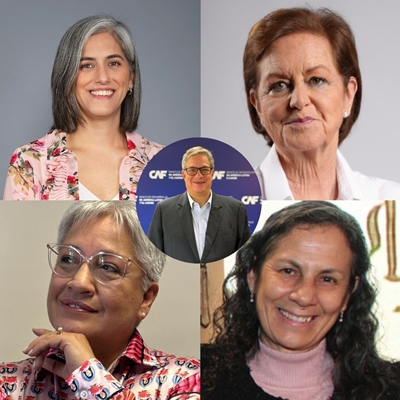
Peru is entering a new phase amidst deep social, institutional and cultural divisions. Four women with different backgrounds have taken on an unusual challenge: to consider the country beyond ideological differences, and to ask themselves what we need to rebuild if we hope to restore trust, strengthen democracy and envisage a shared project. Former Minister of Economy and Finance Toni Alva, historian Cecilia Bákula, former Minister and education specialist Patricia Salas O’Brien and the President of the Business Women’s Committee of the Arequipa Chamber of Commerce, María Emilia Ladrón de Guevara, will take part in a discussion moderated by Santiago Rojas, exploring the common ground that offers a glimpse of shared hope for Peru.
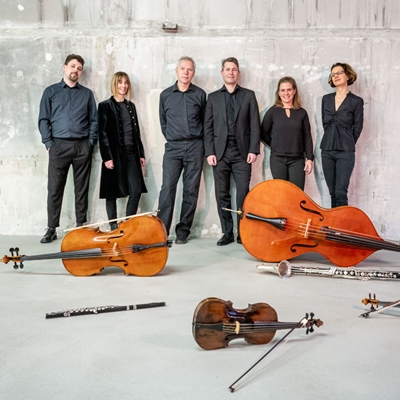
The KNM Berlin Ensemble is one of Europe’s most prestigious contemporary music ensembles. Having grown and established itself as a leading force on the Berlin and German music scenes, it has built an international reputation based on premiering new compositions and working closely with composers from around the world. A regular feature at some of the leading contemporary music festivals, and having performed at iconic venues such as Carnegie Hall in New York and the Teatro Colón in Buenos Aires, the ensemble will give a concert in Arequipa in which experimentation, curiosity and intercultural dialogue will be the hallmarks of the sextet comprising Rebecca Lenton (flute), Theo Nabicht (clarinet, bass clarinet, contrabass clarinet and saxophone), Theodor Flindell (violin), Kirstin Maria Pientka (viola), Cosima Gerhardt (cello) and Jonathan Heilbron (double bass).
Price: S/40.00 (PEN)
With the support of the Goethe-Institut Perú and the Crippled Symmetries project
Workshop with Perú Runners and La Bibliobici de Arequipa
–
Establecimiento penitenciario de hombres de Arequipa
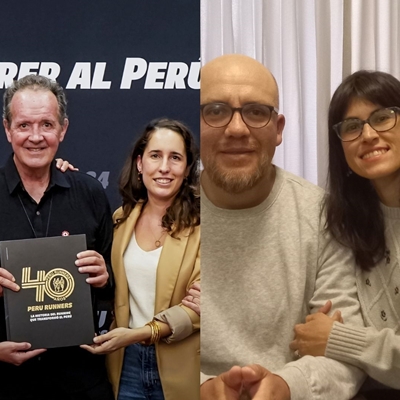
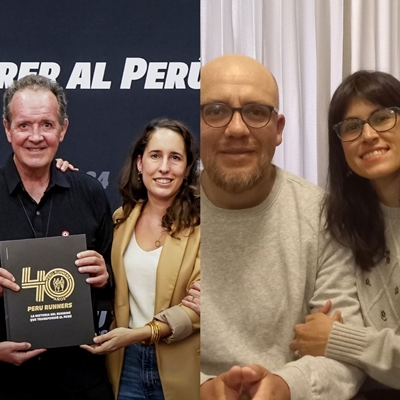
Since 2019, the Hay Festival Arequipa has been organising sessions in men’s and women’s prisons in Arequipa with the aim of reinforcing its commitment to the most vulnerable sections of the community. At this year’s event, Perú Runners, Peru’s largest running organisation, and La Bibliobici de Arequipawill be hosting a workshop led by María José Rodríguez Larraín on the body, movement and breathing.
Mariana Matija (Colombia) is a creative communicator and researcher who explores alternative ways of relating to the Earth, its creatures and its cycles; she is also the author of Niñapájaroglaciar. With an approachable and reflective voice, she sets out a proposal for a conscious and harmonious relationship with nature, based on an everyday, accessible and achievable form of ecology that places the care of the planet at its heart, alongside the possibility of inhabiting the world in a more conscious and harmonious way.
Workshop with Perú Runners and La Bibliobici de Arequipa
–
Establecimiento penitenciario de mujeres de Arequipa
Since 2019, the Hay Festival Arequipa has been organising sessions in men’s and women’s prisons in Arequipa with the aim of reinforcing its commitment to the most vulnerable sections of the community. At this year’s event, Perú Runners, Peru’s largest running organisation, and La Bibliobici de Arequipawill be hosting a workshop led by María José Rodríguez Larraín on the body, movement and breathing.
The very short version goes as follows: Phillip Chu Joy (United States/Peru) went from playing video games to giving away houses. But the story is considerably more complex: a content creator, entrepreneur and promoter of philanthropic initiatives, he spoke for over a decade about technology and video games on the television programme Tec. He currently runs a video game development company and has built a community that combines entertainment, benefits and social action. His life story is told in La diversión es un negocio serio, written by Luis Wong and illustrated by Melissa Siles. He has recently published Aventura infinita, an interactive book featuring games and puzzles. A successful career built on creativity and a desire to do things differently.
Sarah Babiker Moreno and Renata Salecl in conversation with Omar Zevallos
–
Teatro Municipal
How do we cope with a world marked by uncertainty, polarisation and inequality? What levers must we pull to bring about change and move from words to deeds? The Slovenian philosopher and sociologist Renata Salecl, author of Maleducados and El placer de la transgresión, explores how fear, desire, power and social norms shape our decisions and behaviour. Joining her is the Spanish journalist and writer Sarah Babiker Moreno, author of La nada fértil, who reflects on racism, migration, feminism and inequalities from a critical and personal perspective. In conversation with Omar Zevallos, the two will analyse the narratives that shape our societies and the role of critical thinking in imagining fairer ways of living together.
Simultaneous interpretation from English to Spanish available
Price: S/20.00 (PEN)
With the support of Acción Cultural Española, AC/E
Claudia Apablaza and Santiago Roncagliolo in conversation with Ricardo Sumalavia
Cuadernos hispanoamericanos
–
Centro Cultural Peruano Norteamericano (teatro)
The magazine Cuadernos hispanoamericanos promotes understanding and exchange amongst writers of different generations and nationalities, united by a shared language and a literary tradition enriched by these diverse origins. At this special gathering Claudia Apablaza, author of La siembra de las nubes, and Santiago Roncagliolo, author of El pastor y los lobos, will talk about their work and literary worlds with Ricardo Sumalavia.
Price: S/15.00 (PEN)
With the support of the Spanish Agency for International Development Cooperation AECID and PUCP
There are times when it seems as though the world has lost its bearings, and that there is no compass to guide us through its political decisions. Situations in which the established rules appear to be blurring and international relations fluctuate with the emergence of new conflicts, alliances and world orders. The political scientist Farid Kahhat (Peru) attempts to shed some light on current socio-political events in his book of essays El mundo se ha vuelto un lugar extraño, in which he analyses the most relevant issues in contemporary international politics. He will speak to Camila Osorio, El País journalistabout the coordinates needed to navigate such uncertainty.
Cristina Bendek, Carlos Fonseca, Edmundo Paz Soldán and Mayra Santos-Febres
Hay Festival en español podcast: Other Stories from the Archivo de Indias
–
Casa del Moral
Stories change depending on who tells them and from where. Some stories only emerge when we shift our perspective and it is our viewpoint that shapes the narrative. The anthology Otras historias del Archivo de Indias is a project in which 10 writers from Latin America and Spain connect the historical legacy of the Archive with the present of their countries and contexts. Come and learn how an episode of the Hay Festival podcast in Spanish is recorded live, and listen to the reflections of Cristina Bendek, Carlos Fonseca, Edmundo Paz Soldán and Mayra Santos-Febreson their participation in the anthology and their personal perspectives on the project.
–
Centro Cultural Peruano Norteamericano (auditorio)
Founded in 2007, the publishing house Impedimenta was established to “publish the finest works of classic and modern literature”. Almost twenty years on, it has become one of the world’s most prestigious Spanish-language publishers. Its founder, Enrique Redel, talks to bookseller Ana Cañellas about two decades of independent publishing.
Price: S/15.00 (PEN)
With the support of the Spanish Agency for International Development Cooperation AECID and Librerías Cálamo
Toni Alvatenía 34 años cuando asumió el cargo de ministra de Economía y Finanzas del Perú, en uno de los momentos más difíciles de la historia reciente del país, la pandemia. Economista formada desde muy joven en el servicio público, tuvo que tomar decisiones bajo una presión extraordinaria. Después de dejar su cargo, comenzó una nueva etapa profesional vinculada a proyectos internacionales de salud y educación. Desde esos espacios de gestión, su trayectoria dibuja su capacidad de liderazgo, de toma de decisiones y de reinventarse.
Serge Barbet (Francia-Argentina) es un periodista especializado en educación, y es el director del Centro de Educación en Medios e Información (CLEMI, por su siglas en francés), en conversación con XX, hablará sobre alfabetización mediática y la importancia de educar nuevas audiencias, desde la juventud, para que participen de manera más consciente en la vida democrática.
Se ofrecerá interpretación consecutiva del francés al español
El Hay Festival Arequipa y la PUCP invitan al público de todas las edades a una lectura en voz alta de Un mundo para Julius, la emblemática novela de Alfredo Bryce Echenique, una crítica mordaz de la clase alta limeña que evidenció las profundas brechas sociales y la desigualdad en la sociedad limeña y peruana. Conducido por Rossana Díaz Costa.
Carlos Granés and Fietta Jarque in conversation with Katerina Valdivia Bruch
How art can explain a continent
–
Teatro Municipal
Can art explain a continent better than politics or history? Latin America has found in creativity a space to imagine futures, challenge power, preserve memory and reinvent its identity. The Colombian essayist Carlos Granés, author of Delirio americano and El rugido de nuestro tiempo, reflects on the relationship between art, culture and politics in the region. The journalist and writerFietta Jarque (Peru), author of El museo imaginado and known for her long career as a critic and chronicler of the visual arts, explores how Latin American artists have covered the continent’s major transformations and challenged traditional perspectives on its history. These two thinkers will engage in a dialogue alongside the researcher, lecturer and artistic director Katerina Valdivia Bruch.
Luis Nieto Degregori, Karina Pacheco and Miguel Rubio in conversation with Luis Rodríguez Pastor
Yuyachkani: all the country is a stage
–
Centro Cultural Peruano Norteamericano (teatro)
For over half a century, Yuyachkani has used theatre as a way of listening to Peru. Miguel Rubio, the group’s founder, will be in conversation with the writers Luis Nieto Degregori and Karina Pacheco, whose novels have explored many of the questions that have accompanied Yuyachkani: memory, violence, identity, diversity and the possibility of reconciliation. Moderated by Luis Rodríguez Pastor, they will reflect on how art has helped to tell the story of a complex and diverse country, and on the role of creativity when a society needs to remember, understand and reimagine itself.
Greta García and Alessandra Pinasco in conversation with Augusto Carrasco
Literature without filters
–
Centro Cultural Peruano Norteamericano (auditorio)
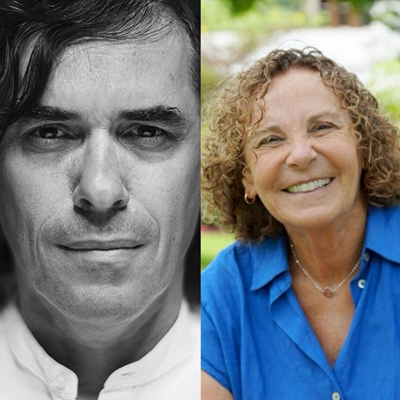
Neither Greta García (Spain) nor Alessandra Pinasco (Peru) write to please. On the contrary, they relish flirting with the irreverent, pushing the boundaries of what is socially acceptable. Pinasco does this in Tan simple, tan puro by tackling one of the taboos of traditional mores: speaking explicitly about sex. Her collection of short stories explores desire, memory and autonomy in a world of hypocrisy and violence. García, meanwhile, does so right from the title — Muere, papá — through biting humour and the premise of imagining the death of her father, José Toro, who, incidentally, illustrates the book.
Price: S/15.00 (PEN)
With the support of Acción Cultural Española, AC/E
Julio Arbizu, Cecilia Bákula, Javier Ciurlizza and José Luis Ramos Salinas in conversation with Patricia del Río
Truth, memory and the challenges that Peru still faces
–
Colegio de Arquitectos
More than two decades ago, the Truth Commission documented the wounds inflicted by the armed conflict. Since then, Peru has made progress in acknowledging past violence, though challenges persist regarding racism, classism, territorial exclusion and the inequalities that run through society. Is knowing the truth enough to move toward reconciliation? How can we build a shared national identity when there are differing ways of interpreting our past? Javier Ciurlizza, Julio Arbizu, Cecilia Bákula and José Luis Ramos Salinas reflect on what we have learned from our history and on the challenges of building a more inclusive and reconciled Peru.
Micaela Chirif and Mariana Matija in conversation with Gracia Angulo
To see the world through wonder
–
Teatro Arequepay
En Niñapájaroglaciar, Mariana Matija(Colombia) writes about the need to rediscover our relationship with nature and with the living beings around us. For her part, Micaela Chirif (Peru) has devoted part of her literary work in recent years to books that bring us closer to national and regional wildlife, such as Animales peruanos, Navegar por los aires andher most recent production: Vida y costumbres de los animales de la Amazonía. Two authors that approach literature from the points of view of nature and of wonder talk to the publisher Gracia Angulo.
From neither here nor there? Or Andalusian and Chinese at the same time? As the daughter of immigrants born in Spain, Quan Zhou has often found herself on both sides of the fence, caught between questioning her own identity and being the target of racist discrimination. These life experiences have been covered by her with intelligence and humour, in autobiographical works such as the comics Gazpacho agridulce and Andaluchinas por el mundo, as well as the graphic essay Gente de aquí, gente de allí. She is also the creator of the documentary podcast Mi familia española, which uncovers an invisible chapter in the recent history of Spain: the experiences of migrant mothers, their children, and the Spanish nannies who looked after them in the 1980s and 1990s, when racial diversity was virtually non-existent.
Mircea Cărtărescu in conversation with Dante Trujillo
The most Macondian Romanian
–
Teatro Municipal
Mircea Cărtărescu (Romania) is one of the most prominent authors in contemporary European literature. A writer with a mystical bent, he has constructed a dreamlike, almost Macondian literary universe in which the real and the imaginary are interwoven with lyrical force. The author himself has remarked that some people view Romania as a Latin American country lost in Europe, and that he agrees with this view. The author of more than twenty books of poetry, fiction and essays, his most recent works translated into Spanish are the monumental Blinding trilogy—considered to be the summit of his literary output, together with Solenoid, Theodoros and Los conocedores. In conversation withDante Trujillo.
Consecutive interpretation from Romanian to Spanish available
Lucho Nieto Degregori and Eloísa Vaello in conversation with Diego Molina Rey de Castro
The diversity of sexual pleasure
–
Centro Cultural Peruano Norteamericano (teatro)
We are sexual beings whose survival depends on biological reproduction. But sexuality is also understood within a socio-cultural context, based on our beliefs and traditions. Lucho Nieto Degregori (Peru) explores the evolution of sexuality in Peru from pre-Inca times to the present day, analysing social transformations from a historical and cultural perspective. It is precisely in the present day that the stories about sexual diversity in En un mundo raro. Antología de voces LGTBIQ+ en español are set. This collection of diverse dissident voices has been co-published by AECID, whose Deputy Director of Cooperation and Cultural Action for Sustainable Development, Eloísa Vaello, will also join the discussion. The session will be moderated by Diego Molina Rey de Castro.
Price: S/15.00 (PEN)
With the support of the Eccles Institute for the Americas and Oceania at the British Library
Carlos Granés and Edmundo Paz Soldán in conversation with Erna von der Walde
Other stories from the Archivo de Indias: viceroyalties and rebellions
–
Centro Cultural Peruano Norteamericano (auditorio)
Otras Historias del Archivo de Indiasis a research project and an artistic initiative in which leading writers from the region engage with the documents held at the Archivo General de Indias. This project, organised by the Hay Festival and CAF, aims to introduce the general public to the archive’s vast collection of documents and to offer a critical and diverse perspective on the multitude of stories that record and challenge the colonial memory of the Americas. These texts have been compiled in the anthology Otras historias del Archivo de Indias, published by Anagrama. Carlos Granés(Colombia) and Edmundo Paz Soldán(Bolivia), who have contributed respectively with the texts La pesadilla del virrey Abascal and La enfermedad del canto: utopía y rebelión en los Andes —written together with Liliana Colanzi—, will talk to the anthology’s editor, Erna von der Walde(Colombia). Event introduced by Santiago Rojas, Northern Regional Manager from CAF.